Upcoming Events

ACB Seminar Series - Dr. Bhagaban Mallik
Dr. Bhagaban Mallik, an Assistant Research Scientist in the Frank Lab, will present a seminar titled "Differential Roles of Intracellular Calcium and Metabolic Energy in Phasic MN-Is and Tonic MN-Ib Motor Neurons."

ACB Seminar Series - Grace Gottschamer
Grace Gottschamer, an Interdisciplinary Graduate Student from the Dunnwald Lab will present a seminar titled " Irf6 and Epidermal Homeostasis."

Anatomy of an Idea - Tom Rutkowski

Anatomy of an Idea - Kathy Andersen

Anatomy of an Idea - Kate Kragness

Anatomy of an Idea - Emily Liu
In The News
Iowa team advances gene treatment to prevent premature skull fusion in newborns
2nd Place in International Hatton Award Competition

Saba Manafi, from the Department of Orthodontics, College of Dentistry at the University of Iowa was awarded the Junior Category Hatton Award for her research entitled “Functional Assessment of an Oculi-auricular-vertebral Spectrum Associated Variant in Zebrafish”. She won the award in both the American Association of Dental, Oral and Craniofacial Research (AADOCR) in New York and the International Association of Dental Research in Barcelona Spain meetings in 2025. Her mentors are Drs. Aline Petrin and Eric VanOtterloo. Congratulations Saba!
HATTON AWARD
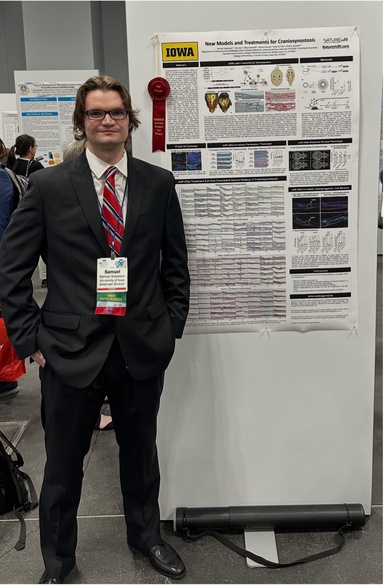
American Association for Dental, Oral, and Craniofacial Research, (AADOCR) Annual Meeting, 2025, New York
HATTON Award--Sam Swearson,
Graduate Student,
First Place Senior Division- New Models and Treatments for Craniosynostosis
CARC Community
Members of the CARC have traditionally been engaged with the broader community of scientists studying the anatomical sciences, craniofacial genetics, and developmental biology. As a testimony of these activities, many of CARC researchers are members of the
American Association for Anatomy (AAA) and of its affiliate Society for Craniofacial Genetics and Developmental Biology (SCGDB). Particularly, Dr. Martine Dunnwald (AAA President 2023-2025) and Dr. Eric Van Otterloo (SCGDB Treasurer 2025-2027) played key roles in these organizations by serving as officers.

The American Association of Dental, Oral, Craniofacial Research (AADOCR) and the International Association of Dental Research (IADR) are the two largest research organizations supporting all types of craniofacial research. It is known for its outreach programs and collaborative research participants. Brad A. Amendt has been involved for many years as President of the Stem Cell Biology Group, Group Program Chair, Symposia organizer, Session chair and abstract reviewer. Dr. Amendt is the IADR Distinguished Scientist in Craniofacial Biology and NIH advocacy day group leader.
Membership to these organizations has increased networking and collaborations amongst CARC members and the scientific community, has allowed many trainees to present their research at local, national and international meetings and be recognized for their talent by winning multiple awards over the years.

Iowa Team Advances Gene Treatment to Prevent Premature Skull Fusion in Newborns
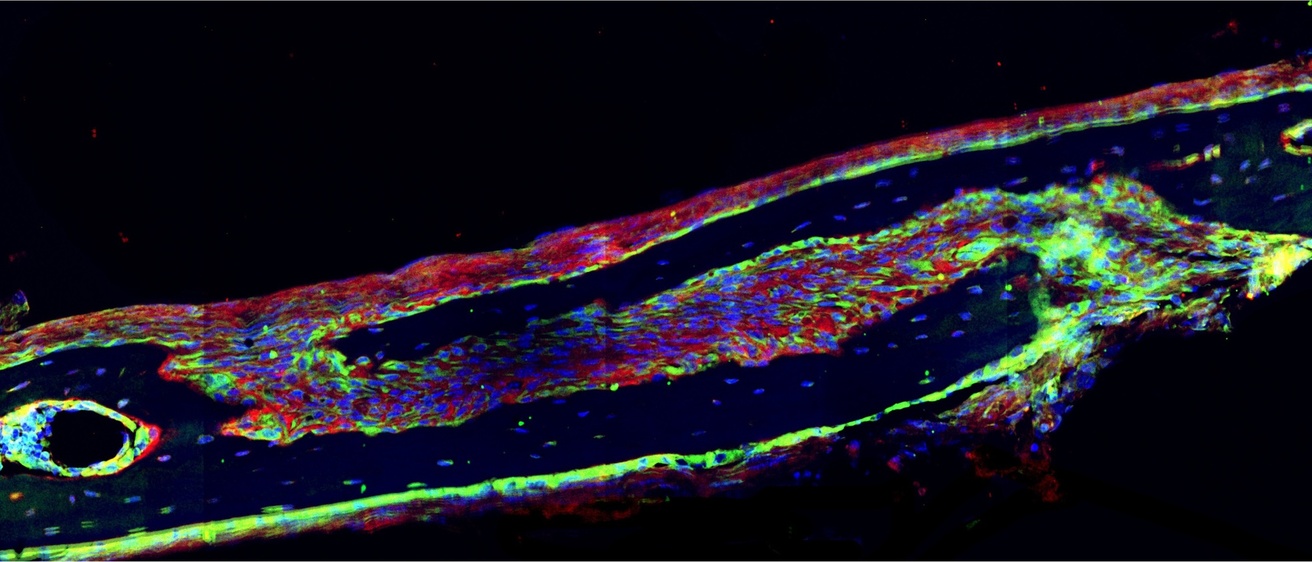
University of Iowa researchers have successfully tested a technique that stimulates a gene to prevent craniosynostosis, a condition that causes infants’ skulls to close prematurely.
Craniosynostosis occurs when one or more joints between the bones of a baby's skull close prematurely, leaving a lack of space for the growing brain to expand. This can cause deformities in head shape and facial appearance if not treated surgically. Some studies have stated the condition can occur in as many as 1 out of 2,200 live births.
The Iowa researchers identified a single gene, miR-200a, and created a nano-sized packet that was injected just below the scalps of newborn mice. The nano-packets migrated to the joint region in the mouse skull and released the miR-200a gene, causing cells to stimulate more production of the gene. That production, known as gene expression, instructed the joints, or sutures in the skull, to not fuse, thus allowing room for the infant mice’s brains to expand.
“This is the first demonstration of a gene therapy approach for craniosynostosis that we know of,” says Brad Amendt, professor of anatomy and cell biology in the Carver College of Medicine, professor of orthodontics in the College of Dentistry, and the study’s corresponding author. “This will save a lot of trauma for children.”